Blog
Blog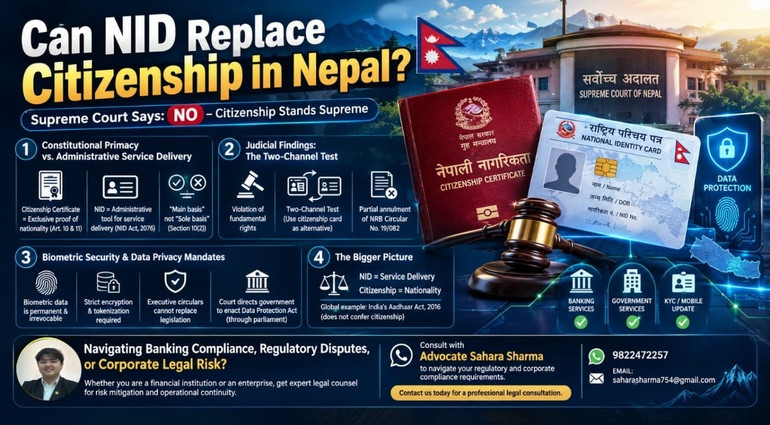
Can NID Replace Citizenship in Nepal?
From the day the Government of Nepal introduced the National Identity Card (NID) to centralize citizen data as mandated by Article 51(Cha) (7) of the Constitution of Nepal, a persistent debate has echoed across society: can the NID replace the traditional citizenship certificate?
The Supreme Court of Nepal answered this dilemma on Ashoj 23, 2083 with a clear “No” in the writ filed by Advocate Sarita Adhikari (Writ No. 082-WO-1514). The petitioner sought to protect the constitutional primacy of citizenship and fundamental property rights after being denied the ability to update her mobile number and KYC details at NIMB Bank based solely on her citizenship card. The Court analyzed the following legal provisions to uphold the supremacy of citizenship:
1. Constitutional Primacy vs. Administrative Service Delivery
The Supreme Court firmly affirmed that under our constitutional framework:
- Constitutional Primacy: Articles 10 and 11 of the Constitution of Nepal establish the citizenship certificate as the exclusive, irrevocable proof of nationality. Citizenship remains the sole foundational proof of a Nepali citizen, whereas the NID is strictly intended as an administrative tool to streamline the delivery of government and public services.
- Administrative Nature of NID: The National Identity Card and Registration Act, 2076 establishes NID and the National Identity Number (NIN) merely as digital tools to streamline service delivery, not to replace constitutional identity.
- “Main Basis” vs. “Sole Basis”: Section 10(2) of the NID Act recognizes NID as a “main basis” (मुख्य आधार) for public services, but it does not make it the absolute “sole basis” (एकमात्र आधार).
2. Judicial Findings: The Two-Channel Test & Annulment of Directives
Addressing the regulatory overreach by financial institutions and regulators, the Court held:
- Violation of Rights: Making NID an absolute bar to basic services due to state administrative backlogs violates fundamental rights.
- The Two-Channel Test: The Court issued a mandamus order requiring institutions to implement a Two-Channel Test, permitting citizens without an NID to use valid alternative identification, primarily the Nepali Citizenship Certificate, for uninterrupted service access.
- Partial Annulment: The Court invalidated Circular No. 19/082 of NRB to the extent that it treated NID as the sole mandatory requirement for basic banking and public access.
3. Biometric Security & Data Privacy Mandates
The Court recognized that compromised biometric details such as fingerprints and iris scans are permanent and irrevocable, and that granting commercial entities database access without rigorous encryption or tokenization threatens privacy rights under Article 28 of the Constitution. It held that executive circulars and internal standards (such as the National Identity Management Information System Security Standards, 2082) cannot substitute for formal legislation. Hence, the Court issued a directive order to the government to formulate and enact a dedicated, comprehensive Data Protection Act through parliament to safeguard citizens’ digital identity and biometric privacy.
4. Conclusion: A Comparative Lens on Digital Identity
Ultimately, the Supreme Court’s intervention underscores a fundamental principle of modern constitutional governance: digital identification cards are designed for efficient service delivery and authentication, not as substitutes for nationality. This distinction mirrors international digital identity frameworks such as India’s Aadhaar Card system under the Aadhaar Act, 2016, where Section 9 explicitly mandates that an Aadhaar number does not by itself confer any right of, or serve as proof of, citizenship or domicile. In Nepal, as across democratic jurisdictions, the National Identity Card remains a powerful tool to streamline administration, but it must always remain subservient to the foundational primacy of the citizenship certificate.
Navigating Banking Compliance, Regulatory Disputes, or Corporate Legal Risk?
Whether you are a financial institution aligning operations with evolving NRB circulars and Supreme Court mandates, or an enterprise managing complex regulatory frameworks, precise legal counsel ensures risk mitigation and operational continuity.
📞 Contact Advocate Sahara Sharma today to schedule a professional legal consultation.
Disclaimer: The content of this article is for informational and educational purposes only and does not constitute formal legal advice. Contacting the author via the details above does not automatically create an advocate-client relationship.