Blog
Blog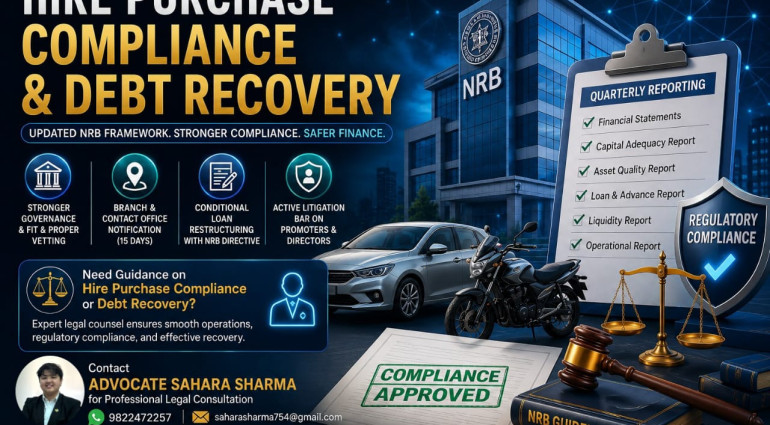
Hire Purchase Laws in Nepal: Key Updates Under NRB’s 6th Amendment (2083)
Hire purchase financing is a major legal and financial pillar for asset acquisition in Nepal. Under this arrangement, ownership of machinery, vehicles, or equipment transfers to the hirer only after the final installment is paid. Operating under Section 76 of the Nepal Rastra Bank Act, 2058, Hire Purchase Companies provide critical credit lines for agricultural, industrial, commercial, and household equipment.
To strengthen institutional governance, risk management, and consumer protection, Nepal Rastra Bank (NRB) recently issued the "Policy and Procedural Provisions Approved for Hire Purchase Companies, 2070 (Sixth Amendment, 2083)".
Here are a breakdown of the regulatory framework and the core amendments every lender, corporate entity, and borrower needs to know.
|
Regulatory Provision |
5th Amendment (2082) |
6th Amendment (2083) |
Legal & Commercial Impact |
|---|---|---|---|
|
Scope of Financed Goods |
Restricted primarily to vehicles, machinery, and industrial equipment |
Expanded to include household electronic appliances (washing machines, refrigerators, vacuum cleaners, dishwashers, etc.) |
Broadens retail financing scope. Lenders can now partner directly with home appliance manufacturers and retailers. |
|
Interest Pricing Mechanism |
Capped lending interest rates using a 4% average interest rate spread over cost of borrowings |
Shifted to a Cost of Funds baseline. Rates must be anchored to Cost of Funds, with individual client rates capped within ±2% of published rates |
Replaces rigid spread caps with dynamic base-cost pricing. Rate changes must be reported to NRB within 3 days. |
|
Vehicle LTV Ratio |
Fixed strict LTV cap of 60% for EVs and personal vehicles |
Harmonized with NRB BFIs Directives. LTV for vehicles now aligns directly with directives for Class 'A', 'B', and 'C' banks and financial institutions |
Establishes a uniform vehicle lending benchmark across banks and non-bank hire purchase institutions. |
|
License Renewal Frequency |
Required license renewal every 2 fiscal years |
Extended license validity to every 10 fiscal years |
Significantly reduces administrative friction and operational compliance burdens. |
|
Service Fee Regulations |
Prohibited service fees beyond the interest rate |
Explicitly permits a loan processing service fee up to 1% of the approved loan amount. However, when services are facilitated via external institutions or retail partners, the institution is permitted to recover associated fees, subject to a strict cap equal to the actual cost incurred. |
Legitimizes transparent loan processing fees while preventing arbitrary charges. |
|
Branch & Contact Offices |
Prior formal NRB approval required to open any branch or contact office |
Allows opening contact offices as needed, requiring written notice to Supervisory Department within 15 days post-opening |
Streamlines network expansion by shifting from pre-approval to post-opening notification. |
|
Promoter & Management Vetting |
Standard fit and proper disclosures under general criteria |
Mandatory Fit & Proper Test for all proposed promoters, shareholders and directors |
Enforces stricter governance standards regarding CIB blacklisting, criminal records, and tax compliance. |
|
Loan Restructuring Provisions |
No explicit statutory mechanism or defined procedure for restructuring hire purchase loans |
Conditional Restructuring Allowed i.e. Permitted only when NRB issues special directives under extraordinary circumstances. Upon an official NRB directive, the BOD may approve restructuring based on a borrower's formal written request with justifiable grounds. |
Establishes a formal restructuring mechanism while preventing discretionary evergreening by lenders during normal market conditions. |
|
Active Loan Recovery Litigation |
No explicit disqualification for individuals undergoing active court litigation prior to conviction |
Any individual facing active court litigation regarding BFI loan misuse/recovery is barred |
Prevents individuals involved in credit disputes across the banking sector from establishing or directing Hire Purchase Companies. |
2. Mandatory Supervisory Reporting & Debt Restructuring Controls
To ensure off-site supervision and monitoring, hire purchase companies must submit six specific quarterly financial and operational reports to Supervisory Department within 15 days following the end of each quarter:
-
Borrowing & Rate Details - Breakdown of institutional borrowings from banks and financial institutions, including borrowing limits, outstanding balances, and interest rates.
-
Portfolio & NPL Statement - Customer-wise loan classification, aging analysis, and calculated loan loss provisions.
-
Top 30 Borrower Exposure - Concentration risk disclosures detailing total credit facilities issued to the top 30 borrowers.
-
Multi-Brand Financing Portfolio - Brand-wise loan distribution tracking multi-brand diversification compliance.
-
Quarterly Financial Statements - Provisional Balance Sheet and Profit & Loss statement.
-
Key Financial Indicators - Core metrics including Net Worth ratios, NPL percentages, times of borrowing on net worth, and upper/lower interest rate boundaries.
Need Guidance on Hire Purchase Compliance or Debt Recovery?
Whether you are a licensed hire purchase company navigating NRB regulatory compliance or a corporate entity structuring commercial asset financing, expert legal counsel ensures smooth operations and risk mitigation.
📞 Contact Advocate Sahara Sharma today to schedule a professional legal consultation.
Disclaimer: The content of this article is for informational and educational purposes only and does not constitute formal legal advice. Contacting the author via the details above does not automatically create an advocate-client relationship.